

 By Dr. Himanshu Singh, MBBS, D'Ortho, DNB (Orthopaedics)
The shoulder is the most mobile joint in the body — and the one that dislocates most often. Most dislocations are anterior: the ball (humeral head) is forced out of the front of the socket (glenoid), typically during a fall on an outstretched arm, a tackle, or a forceful throwing movement.
What a dislocation damages
- Bankart lesion: the labrum — the cartilage rim that deepens the socket — is torn off the front of the glenoid. See labral tears.
- Bony Bankart: a fragment of the socket's rim breaks off.
- Hill-Sachs lesion: a dent in the back of the ball where it struck the socket edge.
- Rotator cuff tear: more likely in people over 40 — see rotator cuff tears.
- Occasionally, injury to the axillary nerve.
Symptoms of instability
- The shoulder "slips out" or fully dislocates again
- Fear or apprehension when lifting the arm overhead or out to the side
- Clicking, weakness or a "dead arm" feeling
- Avoiding sports or sleeping positions
Imaging that helps decide
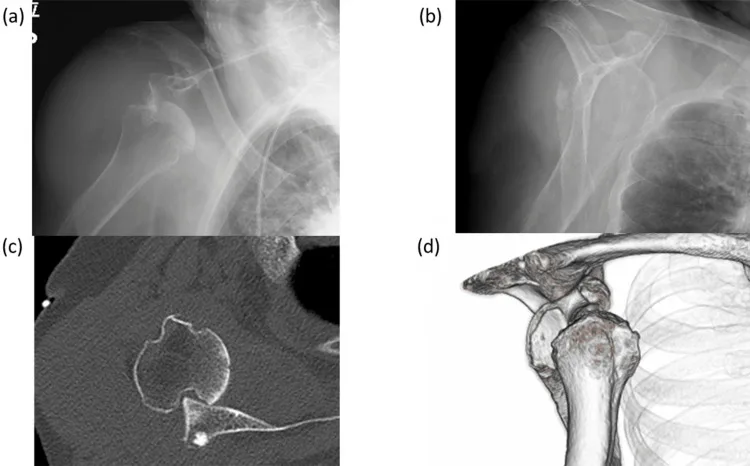
- X-rays to confirm the joint is back in place and check for fractures
- MRI or MR arthrogram for the labrum, capsule and rotator cuff
- 3D CT scan to measure glenoid bone loss and Hill-Sachs size — critical in deciding the right operation
Treatment options
Physiotherapy
After a first dislocation, a short period in a sling followed by structured rotator cuff and shoulder-blade strengthening. Suitable for many patients, especially those not in high-risk sports.
Arthroscopic Bankart repair
A keyhole operation that reattaches the torn labrum and tightens the capsule using small anchors. Suited to recurrent instability with little bone loss. A remplissage may be added for an engaging Hill-Sachs lesion. Read more about arthroscopic Bankart repair.
Latarjet / bone-block stabilisation
When there is significant bone loss from the socket, or a previous repair has failed, a block of bone (the coracoid, or a bone graft) is fixed to the front of the glenoid. It restores the socket's surface and acts as a sling. Read more about the Latarjet procedure.
Recovery after stabilisation
Typical timeline in my practice; your plan may differ.
- Sling for about 4–6 weeks, with guided gentle movement
- Strengthening from around 6–12 weeks
- Return to contact or throwing sport around 5–6 months
See the shoulder recovery guide.
Why recurrent dislocation should be addressed
Each dislocation can wear away more bone and labrum, making the eventual repair more complex and increasing the risk of arthritis. If your shoulder has dislocated more than once, or keeps feeling unstable, a specialist opinion is worthwhile.
Frequently asked questions
Will my shoulder dislocate again?
The risk depends mostly on age and activity. Young people who play contact or overhead sports have a high risk of recurrence after a first dislocation, while recurrence is less common in people over 40, where rotator cuff tears become a bigger concern.
Should I have surgery after my first dislocation?
For many people, physiotherapy is the first step. Early stabilisation may be advised for young athletes in high-risk sports, or when scans show significant bone loss or a large labral tear.
Why do I need a CT scan as well as an MRI?
MRI shows soft tissue such as the labrum and capsule. A 3D CT scan precisely measures bone loss from the socket (glenoid) or the ball (Hill-Sachs lesion), which decides between a soft-tissue repair and a bone-block procedure like Latarjet.
Medical disclaimer: this article is general information, not a diagnosis. Every injury is different — please consult an orthopaedic surgeon with your scans before deciding on treatment.