

 By Dr. Himanshu Singh, MBBS, D'Ortho, DNB (Orthopaedics)
A malunion is a fracture that has healed — but in the wrong position. The bone may be angled (bent), rotated (twisted), shortened, or translated (shifted sideways). Many malunions are small and harmless; others change how weight passes through the hip, knee and ankle and lead to pain, limp and early arthritis.
Common signs of malunion
- The leg or arm looks bent, or the foot points inwards or outwards
- A limp, or one leg feels shorter
- Knee or ankle pain that started after the fracture healed
- Difficulty with stairs, squatting or sport
- In the forearm: difficulty turning the palm up or down
How malunion is measured
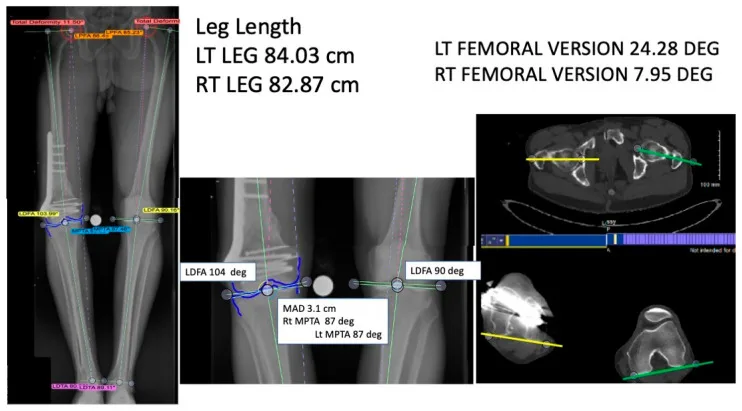
Correcting a malunion is an exercise in precision. The plan starts with measurement:
- Full-length standing X-rays (hip to ankle) to measure the mechanical axis and joint angles.
- CT scan with rotational cuts to measure twist (torsion) accurately.
- Block test to measure true limb-length difference.
- Assessment of nearby joints, skin and previous scars.
From these images the CORA (centre of rotation of angulation) is identified — the point where the deformity is best corrected. This is the same principle used in all limb deformity correction.
Treatment options
Acute correction with internal fixation
The bone is cut (osteotomy) at the planned level, realigned in one step, and fixed with a plate or intramedullary nail. Suitable for angular and rotational malunions without significant shortening.
Nail-based correction
In the femur and tibia, an osteotomy combined with a nail ("fixator-assisted nailing") gives strong fixation with small incisions and allows early walking.
Gradual correction with Ilizarov or hexapod frames
When there is shortening plus angulation, poor skin, previous infection, or a large deformity, a circular frame allows the bone to be corrected millimetre by millimetre. Hexapod frames use software to correct length, angle and rotation simultaneously. Gradual correction also protects nerves and blood vessels.
Lengthening over nail (LON)
For shortening, the bone can be lengthened over a nail, reducing the time a frame needs to stay on.
See a real case
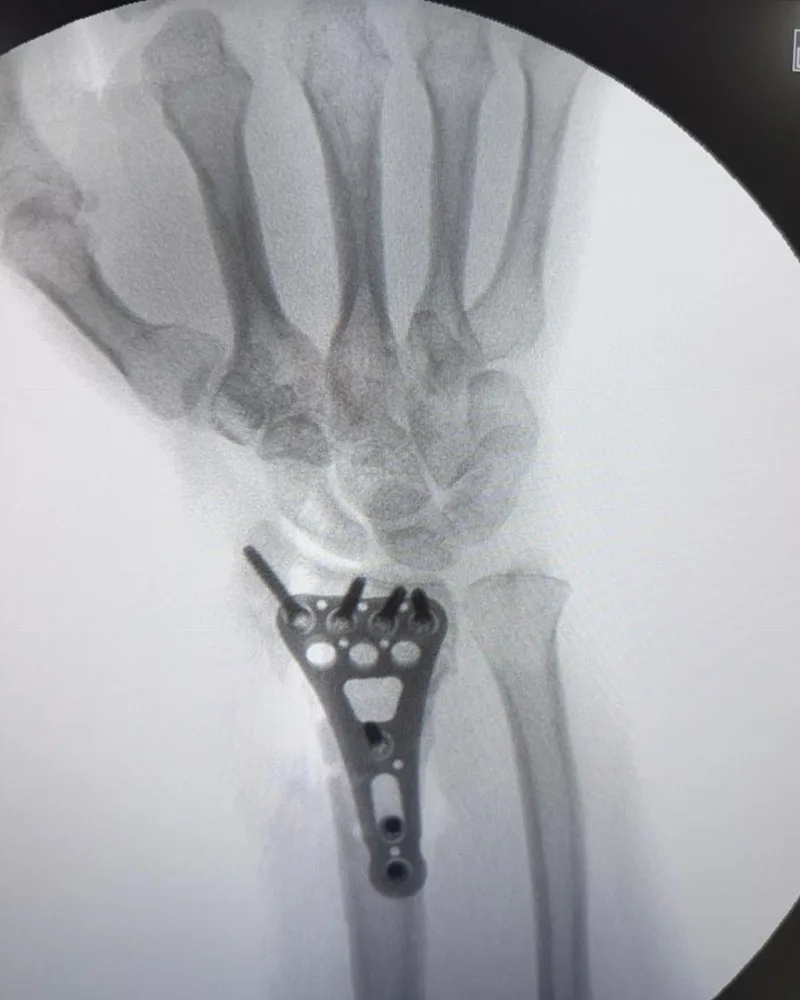
Shared with written patient consent, identifying details removed. Individual outcomes vary.
Recovery
Typical timeline in my practice; your plan may differ.
- Acute correction: walking with support within days; bone healing in 3–4 months.
- Gradual correction: the frame stays through correction plus consolidation — roughly 1 month per centimetre of lengthening in adults, guided by X-rays.
Why a second opinion matters
Two patients with "the same" crooked leg may need completely different operations. Bring every X-ray since the original injury, your operation notes and any CT scans — they let the deformity be planned accurately before any decision is made.
Frequently asked questions
Does every malunion need surgery?
No. Small angulations, especially in the upper limb, are often well tolerated. Correction is advised when the deformity causes pain, limp, joint overload, shoe-raise dependence, or visible cosmetic concern that matters to the patient.
Can a malunion be corrected years after the fracture?
Yes. Malunions can be corrected many years later. Earlier correction is preferred in the leg because long-standing malalignment can damage the knee or ankle cartilage.
Will I need an external fixator?
Not always. Simple angular malunions are often corrected with an osteotomy and internal fixation (plate or nail). A frame is preferred when there is shortening, multi-plane deformity, infection or poor skin.
Medical disclaimer: this article is general information, not a diagnosis. Every injury is different — please consult an orthopaedic surgeon with your scans before deciding on treatment.