

 By Dr. Himanshu Singh, MBBS, D'Ortho, DNB (Orthopaedics)
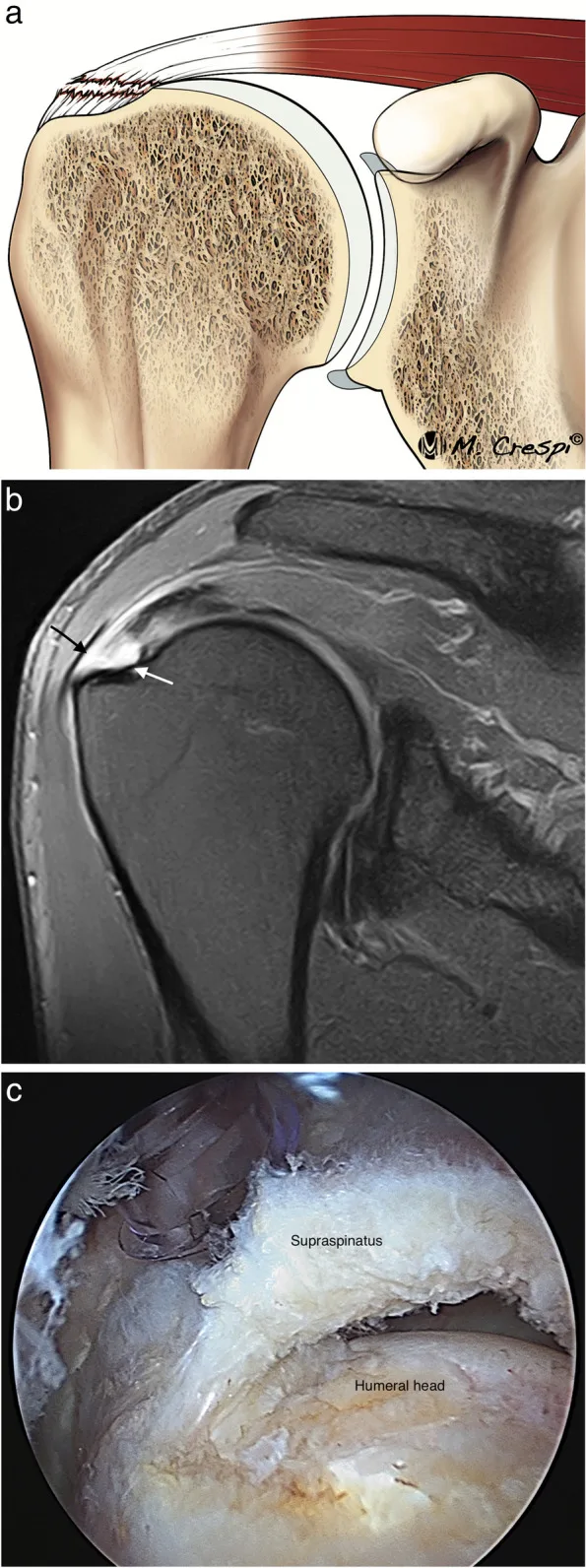
The rotator cuff is a group of four tendons that wrap around the ball of the shoulder. They keep the ball centred in the socket and lift and rotate the arm. Tears are very common, especially after 40 — sometimes after a fall or lifting injury, often gradually with age-related wear.
Symptoms
- Pain on the outer side of the upper arm, worse at night and lying on the affected side
- Pain or weakness lifting the arm overhead or reaching behind
- Difficulty combing hair, dressing or reaching a shelf
- Clicking or catching
- Sudden loss of lift after an injury — suggests an acute tear needing early assessment
Types of tears
- Partial-thickness: the tendon is frayed but not torn through
- Full-thickness: a hole through the tendon, from small to massive
- Traumatic: sudden tear in a previously healthy tendon — better results with early repair
- Degenerative: develops over years, often with bone spurs and impingement
Diagnosis
Examination tests specific strength and movement of each cuff tendon. X-rays show bone spurs, arthritis and the position of the ball. MRI is the key scan — it shows tear size, retraction and muscle quality (fatty change), which predict whether repair will heal. Ultrasound is a useful alternative in some cases.
Treatment options
Non-surgical
- Physiotherapy focused on the cuff and shoulder-blade muscles
- Activity modification and pain relief
- Image-guided injections for pain relief to allow rehabilitation
Many partial and degenerative tears do well with this approach.
Arthroscopic rotator cuff repair
Through small keyhole incisions, the torn tendon is reattached to bone with suture anchors, in a single- or double-row configuration. Bone spurs can be removed at the same time. Repair is recommended for:
- Acute traumatic tears in active patients
- Tears causing persisting pain and weakness despite physiotherapy
- Tears in younger patients, before the tendon retracts and the muscle weakens
Massive or irreparable tears
Partial repair, superior capsular reconstruction, tendon transfer, or reverse shoulder replacement for older patients with arthritis and loss of elevation.
Recovery after repair
Typical timeline in my practice; your plan may differ.
- Sling for about 4–6 weeks while the tendon heals to bone
- Assisted movement first, then active movement from about 6 weeks
- Strengthening from about 3 months
- Most daily activities by 3–4 months; full strength 6–12 months
See the shoulder recovery guide.
Don't ignore persistent shoulder pain
Not all shoulder pain is a cuff tear — frozen shoulder, arthritis and labral tears can feel similar. A precise diagnosis is the first step to the right treatment.
Frequently asked questions
Can a rotator cuff tear heal without surgery?
Partial tears and many degenerative tears in older adults improve with physiotherapy, as surrounding muscles compensate. Full-thickness tears do not heal back to bone on their own and may enlarge over time, particularly after an injury in an active person.
Is an MRI needed for rotator cuff tears?
MRI is the most useful scan for rotator cuff tears. It shows the size of the tear, how far the tendon has retracted, and whether the muscle has become fatty — all of which decide whether repair is likely to succeed.
What if the tear is too large to repair?
Options for massive irreparable tears include partial repair, tendon transfers, superior capsular reconstruction, and reverse shoulder replacement in older patients with arthritis or loss of arm elevation.
Medical disclaimer: this article is general information, not a diagnosis. Every injury is different — please consult an orthopaedic surgeon with your scans before deciding on treatment.