

 By Dr. Himanshu Singh, MBBS, D'Ortho, DNB (Orthopaedics)
A broken bone normally heals in 6–12 weeks in the upper limb and 3–6 months in the leg. When healing stops altogether, the fracture is called a non-union. Patients usually describe persistent pain, swelling, a feeling of movement at the break, a bent or broken implant, or simply being unable to bear weight months after the injury.
Non-union is one of the commonest reasons patients are referred for limb reconstruction — and with the right plan, the large majority can be healed.
Why do fractures fail to unite?
Bone healing needs three things: stability, blood supply (biology) and the absence of infection. A non-union almost always means one or more of these is missing.
- Mechanical causes: fixation that is too flexible or too rigid, an implant that has broken or loosened, or a gap left between fragments.
- Biological causes: high-energy injuries that stripped the bone of its blood supply, open fractures, extensive surgical dissection.
- Infection: low-grade infection can silently prevent healing — see our guide on infected non-union.
- Patient factors: smoking, diabetes, vitamin D deficiency, poor nutrition, some medicines (steroids, certain painkillers).
Types of non-union
| Type | What X-rays show | What it usually needs |
|---|---|---|
| Hypertrophic | Plenty of callus ("elephant foot") but no bridging | More stability — biology is good |
| Oligotrophic | Little callus, reasonable alignment | Stability plus stimulation |
| Atrophic | Thin, rounded bone ends, no callus | Biology — bone graft, freshening of ends |
| Infected | Sequestrum, sinus, loose implant | Debridement and staged reconstruction |
How is non-union diagnosed?
- Clinical examination — pain or movement at the fracture site, alignment, leg length, skin condition.
- X-rays in two planes, and full-length standing X-rays if the leg is short or crooked.
- CT scan — the most reliable way to confirm whether bone is bridging.
- Blood tests — ESR, CRP, counts, vitamin D, sugar, and thyroid where relevant.
- Cultures taken at surgery if infection is suspected.
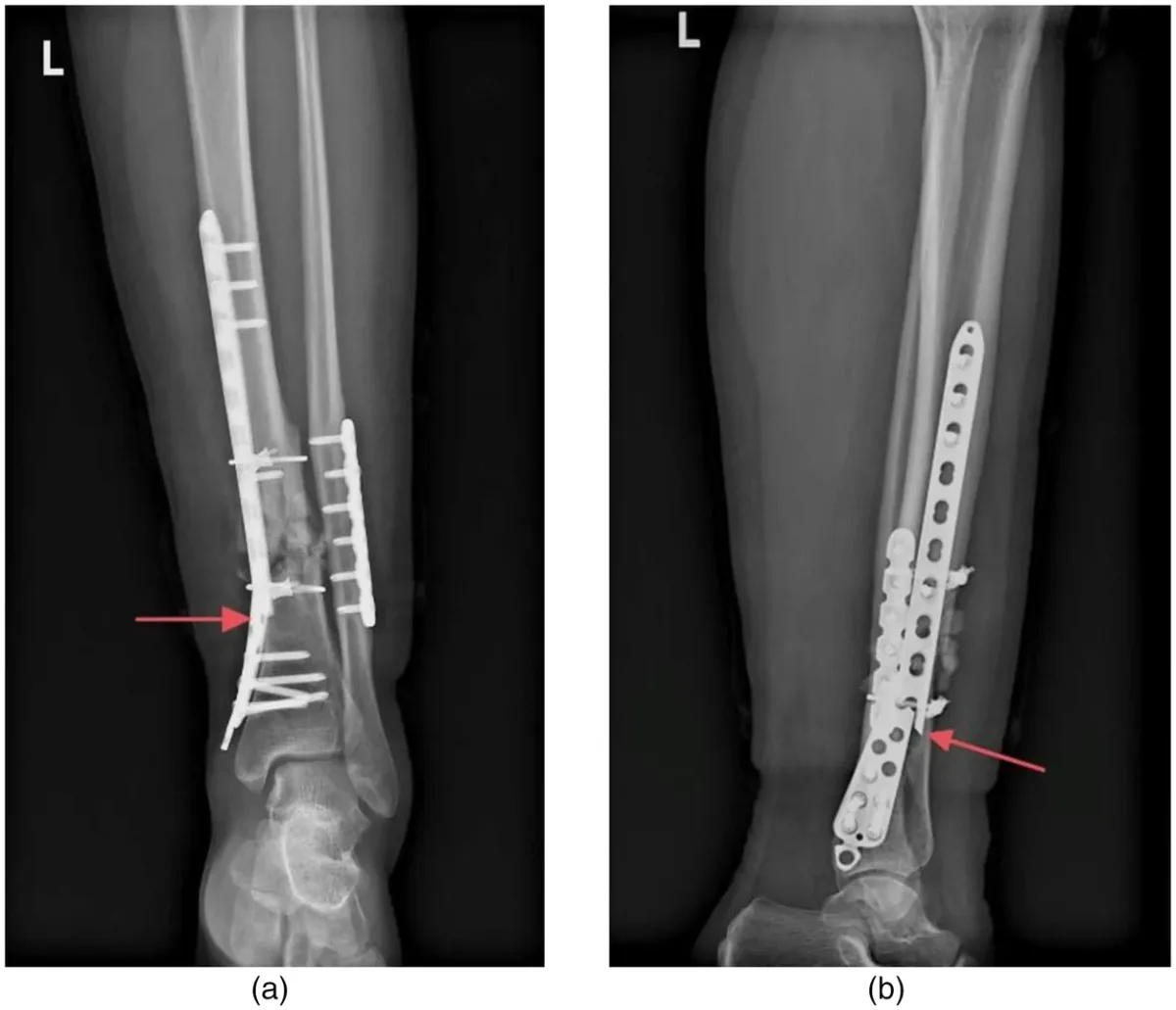
Treatment options
Revision fixation and bone grafting
For many hypertrophic and some atrophic non-unions, removing the failed implant, stabilising with a stronger plate or nail, and adding the patient's own bone graft (usually from the pelvis) is enough.
Exchange nailing
In long bones like the femur and tibia, reaming and inserting a larger nail improves stability and stimulates healing.
Ilizarov ring fixator
The Ilizarov method treats non-union, shortening, deformity and infection in a single plan. Thin wires and rings hold the bone securely while allowing early weight bearing, which itself stimulates healing. The frame can compress the non-union, correct angulation and — if needed — lengthen the bone or transport a segment to fill a gap.
Correcting the underlying cause
Stopping smoking, correcting vitamin D and controlling blood sugar can make the difference between success and failure.
Key point: the operation that healed the first fracture is rarely the right answer for a non-union. Treatment must address the specific reason the bone stopped healing.
See a real case
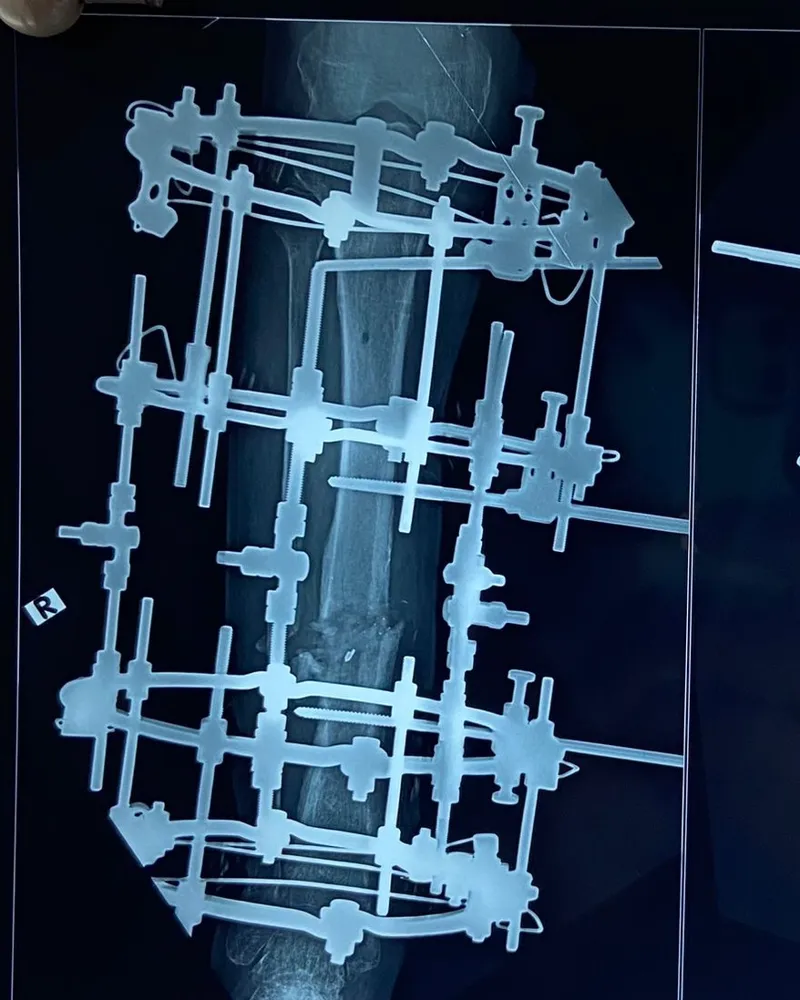
Shared with written patient consent, identifying details removed. Individual outcomes vary.
What recovery looks like
Typical timeline in my practice; your plan may differ.
Most patients walk with support soon after surgery. Healing is tracked with X-rays every 4–6 weeks. With plating or nailing, union typically takes 3–6 months; with an Ilizarov frame, the frame stays until X-rays and CT confirm solid bone.
When should you seek an opinion?
- Pain at a fracture site 3 months after injury
- A bent, broken or loose implant on X-ray
- A wound that keeps discharging over a fracture
- A limb that has become shorter or crooked
Bring every X-ray since the injury, operation notes and implant details to your consultation — the sequence of X-rays often tells the story of why the bone did not heal.
Frequently asked questions
How long before a fracture is called a non-union?
A fracture is usually called a non-union when it has not healed by 6–9 months and X-rays show no progress over the last three months. A delayed union is one that is healing slower than expected but still progressing.
Can a non-union heal without surgery?
Occasionally, a stable non-union with a correctable cause (such as smoking or vitamin D deficiency) may heal with bracing and weight bearing. Most established non-unions need surgery to correct the biological or mechanical problem.
Is the Ilizarov method used for every non-union?
No. Many non-unions heal with revision plating or nailing and bone grafting. The Ilizarov frame is preferred when there is infection, bone loss, shortening, deformity or poor soft tissue.
Medical disclaimer: this article is general information, not a diagnosis. Every injury is different — please consult an orthopaedic surgeon with your scans before deciding on treatment.