


 By Dr. Himanshu Singh, MBBS, D'Ortho, DNB (Orthopaedics)
Severe road traffic injuries, open fractures, tumours and bone infection can leave a gap where a segment of bone has been lost or had to be removed. A gap of more than 2–3 cm will not heal on its own and cannot be bridged reliably with ordinary bone graft. For many years, large defects led to amputation. Today, the Ilizarov method allows the body to grow new bone to fill the gap.
How bone transport works
Bone transport is based on distraction osteogenesis — the discovery by Prof. G. A. Ilizarov that bone which is gently and gradually pulled apart forms new, living bone in the space created.
- The limb is stabilised in a circular frame.
- A healthy segment of bone is cut (corticotomy) away from the defect, with care to preserve its blood supply.
- After a short latent period, the segment is moved towards the gap at about 1 mm per day, in small increments.
- New bone ("regenerate") forms behind the moving segment.
- When the segment reaches the other end (the "docking site"), the ends are compressed, sometimes with a small bone graft, until they unite.
- The regenerate matures and hardens; the frame is then removed.
Soft tissue — skin, muscle, vessels and nerves — is also gently lengthened, which is why the method is so effective in limbs scarred by trauma.
Other options for bone defects
| Technique | Suited to |
|---|---|
| Acute shortening and re-lengthening | Moderate defects where closing the gap helps wound closure |
| Induced membrane (Masquelet) technique | Defects with good soft tissue; uses a cement spacer then bone graft |
| Vascularised fibula graft | Selected upper-limb or long defects |
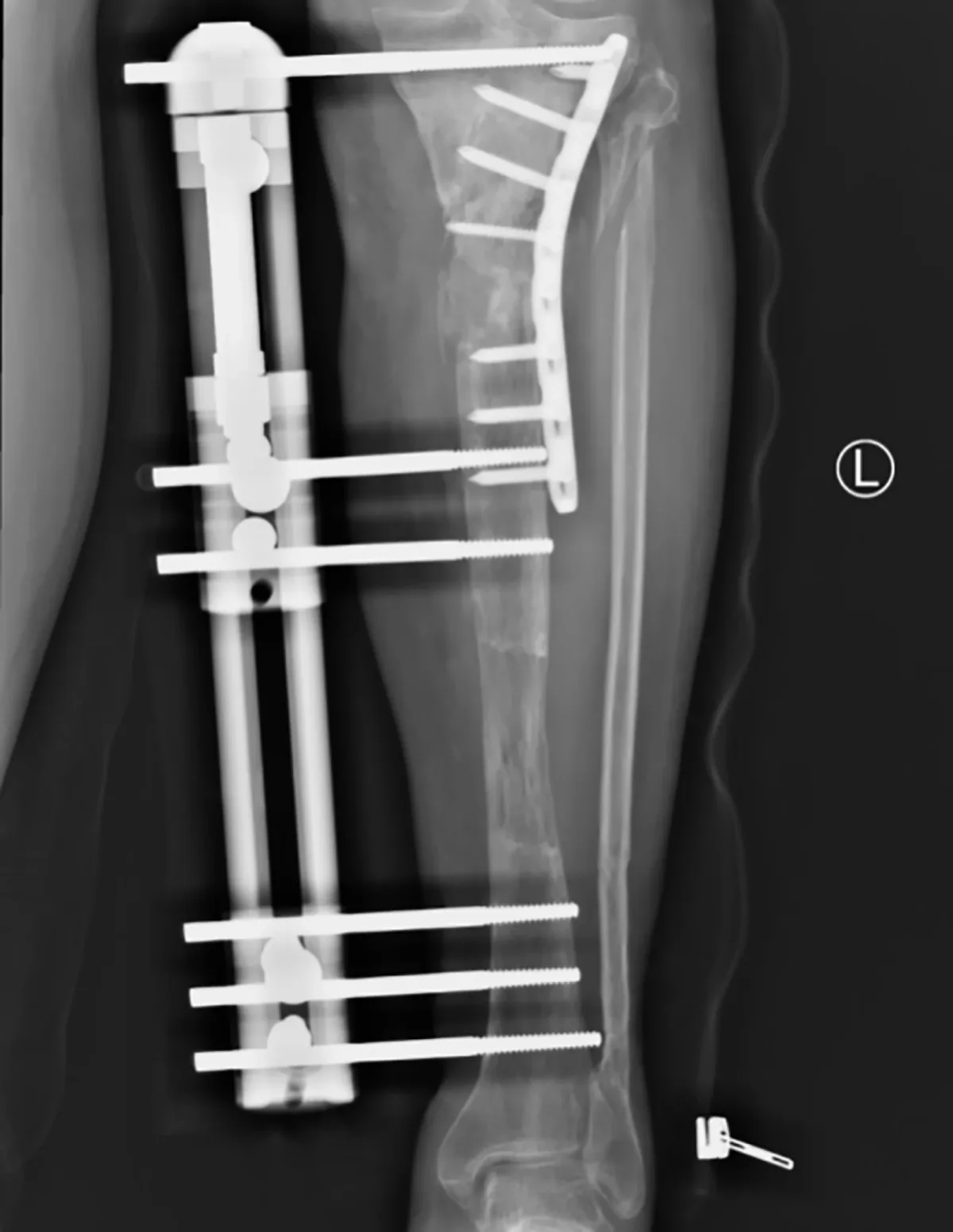
| Bone transport over a nail or plate | Shortens frame time in suitable patients |
Often these are combined. The choice depends on the size and location of the defect, infection, the skin, and the patient's priorities.
See a real case
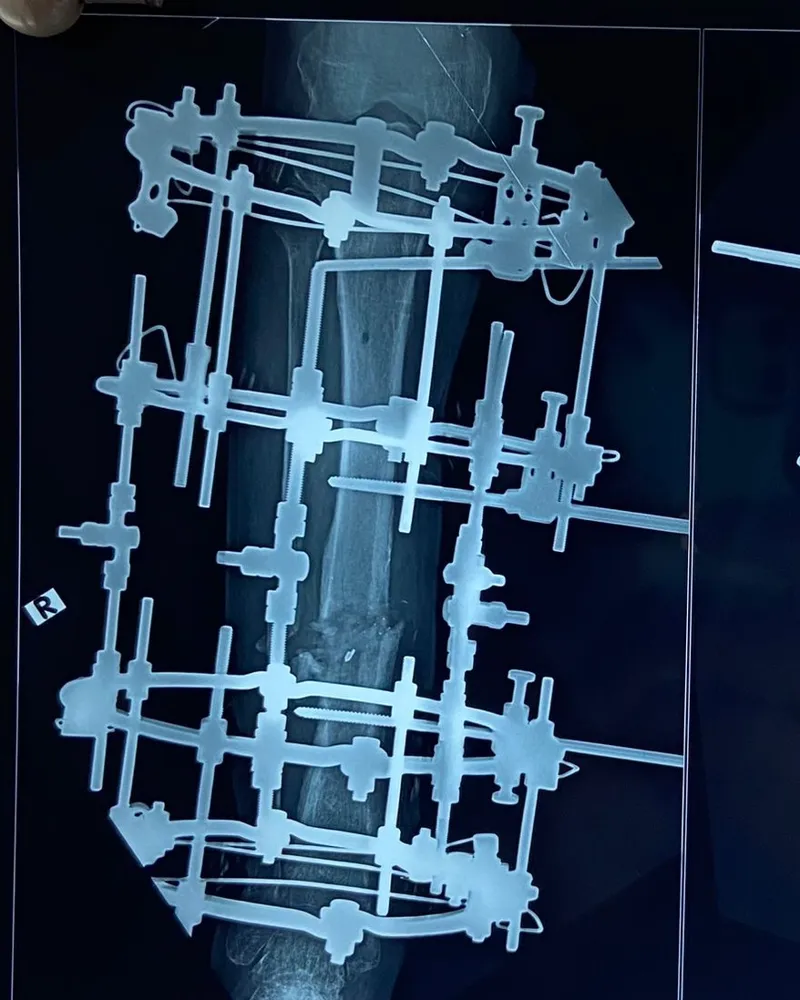
Shared with written patient consent, identifying details removed. Individual outcomes vary.
Living with a transport frame
Typical timeline in my practice; your plan may differ.
- Most patients walk with the frame, often bearing weight — this helps the new bone form.
- Daily pin-site care is taught before discharge.
- X-rays every 2–4 weeks track the regenerate.
- Physiotherapy keeps the knee and ankle mobile and prevents contractures.
Read more about life with a frame in our recovery guide.
Bone gaps with infection
Many gaps result from infection. In these cases infected bone must first be removed completely — see infected non-union and bone infection. The Ilizarov method is especially valuable here because the wires sit away from the infected zone and no large implant is left inside.
Is limb salvage possible for me?
If you've been told the gap is too large, the infection too long-standing or the limb not worth saving, a limb reconstruction opinion is worthwhile. Bring all X-rays, CT scans, culture reports and operation notes.
Frequently asked questions
How large a bone gap can be filled with bone transport?
Bone transport can fill very large defects — gaps of 10 cm or more have been reconstructed. The time needed increases with the size of the gap, so treatment is planned individually.
Is the new bone as strong as normal bone?
Yes. Distraction osteogenesis forms living bone that remodels over time to resemble the surrounding bone. Once fully consolidated it carries full body weight.
How long does bone transport take?
Transport usually proceeds at about 1 mm a day, followed by a consolidation phase. As a rough guide, total frame time in adults is around 1–1.5 months per centimetre of gap, varying with age and health.
Medical disclaimer: this article is general information, not a diagnosis. Every injury is different — please consult an orthopaedic surgeon with your scans before deciding on treatment.