


 By Dr. Himanshu Singh, MBBS, D'Ortho, DNB (Orthopaedics)
A multi-ligament knee injury means two or more of the four major knee ligaments are torn at the same time: the ACL, the PCL, the medial collateral ligament (MCL), and the lateral collateral ligament with the posterolateral corner (PLC). These injuries are uncommon but serious. Most follow road accidents, falls from height or high-energy sports collisions, and many are actually knee dislocations, even if the knee went back in by itself before reaching hospital.
First priority: the blood vessels and nerve
When the knee dislocates, the popliteal artery behind the knee and the peroneal nerve on the outer side can be damaged:
- Pulses in the foot are checked, and the ankle–brachial index (blood pressure in the ankle compared with the arm) is measured
- CT angiography is done if there is any doubt, as vascular injury can be limb-threatening
- Foot drop or numbness on the top of the foot suggests peroneal nerve injury
A 2026 review stresses a low threshold for CT angiography, because the injury pattern alone does not reliably predict which knees have a damaged artery.
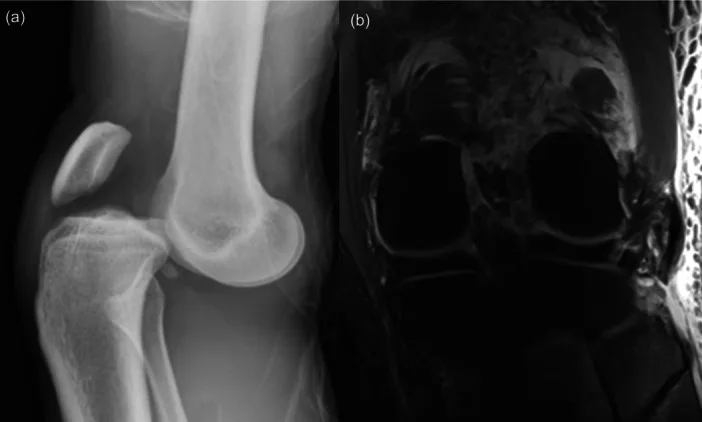
Diagnosis
- X-rays: dislocation, fractures, small bone avulsions
- MRI: the standard for mapping exactly which ligaments, tendons and menisci are torn
- Stress X-rays: to measure looseness, especially for PCL and posterolateral corner injuries
- Injuries are grouped by the Schenck classification (KD I–V) according to which ligaments are torn and whether there is a fracture
Treatment
Surgery is the treatment of choice for active patients. The key decisions are timing and how to stabilise the knee:
| Situation | Usual approach |
|---|---|
| Stable limb, no vascular injury | Single-stage reconstruction of all torn structures, ideally within 2–3 weeks |
| Vascular repair, open wound, severe swelling | Knee-spanning external fixator first; ligament reconstruction staged later |
| Fracture-dislocation (tibial plateau or femur) | Fracture fixation plus ligament repair/reconstruction, often with a hinged external fixator |
| Chronic dislocation or persistent subluxation | Reduction, reconstruction and a hinged external fixator to hold the knee while allowing movement |
According to the 2026 review, reconstructing all injured structures in a single stage within the first two to three weeks is associated with less secondary meniscal and cartilage damage. Your own tendon (autograft) is preferred for the ACL in young patients. Autograft and donor tendon (allograft) perform comparably for the PCL and collateral ligaments.
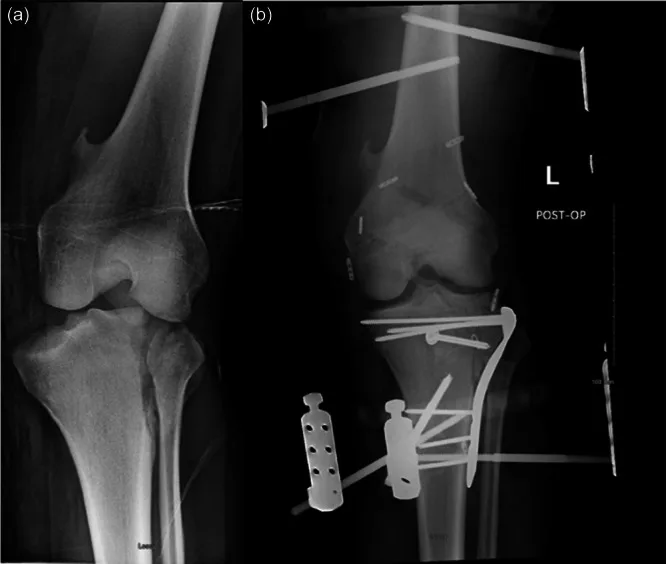
The role of external fixation
A hinged external fixator is a frame outside the leg with a hinge aligned to the knee's axis. A 2025 systematic review found it is mainly used for acute and chronic dislocations, combined bone and ligament injuries, associated vascular or soft-tissue injury, and to protect extensive reconstructions. It holds the knee in joint while still allowing early controlled bending, which helps prevent stiffness, the commonest problem after these injuries.
This is where training in Ilizarov and limb reconstruction helps: complex knees with fractures, bone loss, infection or chronic dislocation can be managed with frames as well as plates and grafts.
See a real case
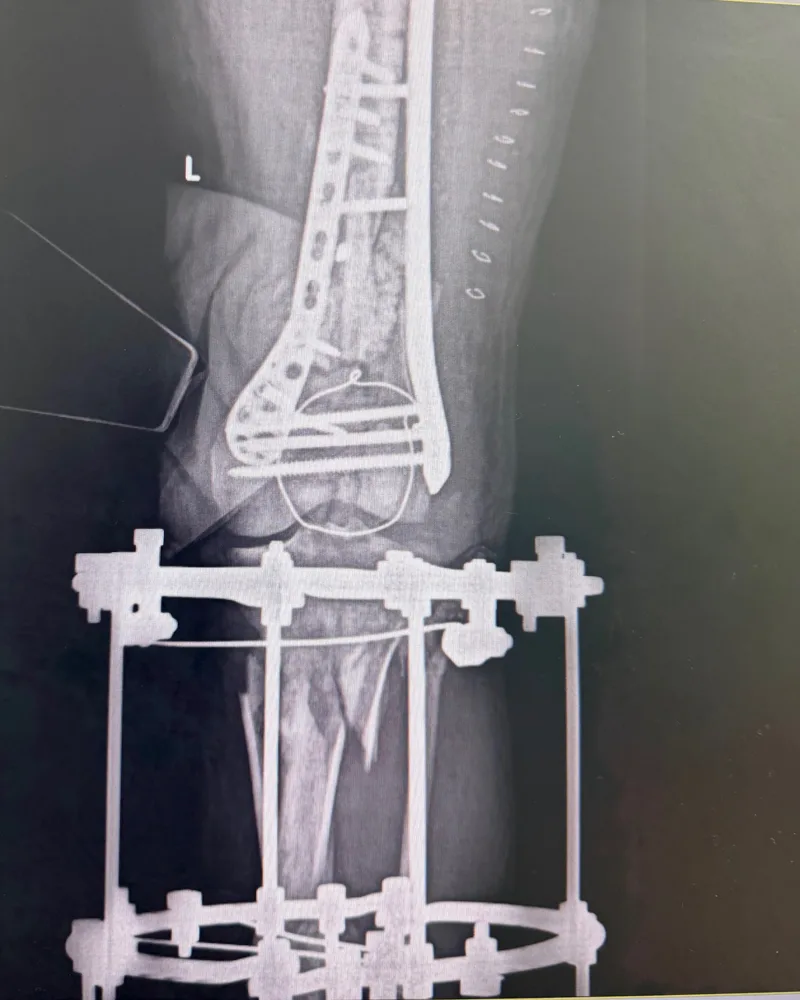
Shared with written patient consent, identifying details removed. Individual outcomes vary.
Recovery
Typical timeline in my practice; your plan may differ.
| Time | What to expect |
|---|---|
| 0–6 weeks | Brace or hinged frame; protected weight-bearing; early guided movement |
| 6–12 weeks | Gradual full weight-bearing; restoring full straightening and bending |
| 3–6 months | Strengthening, balance, cycling |
| 6–9 months | Running and agility work |
| 9–12 months+ | Return to sport or heavy work for many patients |
Stiffness is the most common early problem. A 2026 study found that patients who needed a later release of scar tissue (arthrolysis) still had good long-term outcomes. Strength of the thigh muscles can take more than a year to recover, so long-term rehabilitation matters.
Key message
If a knee "came out" in an accident, even if it went back in, it needs urgent assessment of the blood supply, then an MRI and a clear surgical plan. Early, anatomical reconstruction gives the best chance of a stable, functional knee.
Frequently asked questions
Why is a knee dislocation an emergency?
When the knee dislocates, the main artery behind the knee (the popliteal artery) and the peroneal nerve can be stretched or torn. A damaged artery can threaten the leg, so pulses and blood pressure in the foot are checked immediately, with CT angiography if there is any doubt, even if the knee has already gone back into place.
When should the ligaments be reconstructed?
In active patients, reconstructing all the injured ligaments in one operation within about two to three weeks of injury is associated with less later damage to the meniscus and cartilage. If there is vascular injury, an open wound or a fracture, the knee is first stabilised with an external fixator and reconstruction is staged.
Will my knee be normal again?
Multi-ligament injuries are serious, and some stiffness or residual looseness is common. With well-timed anatomical reconstruction and dedicated rehabilitation, most patients regain a stable knee for daily activities, and many return to work and sport, though recovery takes 9 to 12 months.
Medical disclaimer: this article is general information, not a diagnosis. Every injury is different — please consult an orthopaedic surgeon with your scans before deciding on treatment.