


 By Dr. Himanshu Singh, MBBS, D'Ortho, DNB (Orthopaedics)
Bow legs (genu varum) shift body weight onto the inner (medial) side of the knee. Over the years, that overload wears the cartilage and causes medial knee arthritis: pain on the inner side when walking, standing or climbing stairs. A high tibial osteotomy (HTO) realigns the shin bone just below the knee so that weight passes through the healthier outer side.
This is joint preservation: your own knee is kept, not replaced.
Who benefits most?
- Active adults, typically under about 60, who want to stay active
- Pain on the inner side of the knee
- Bow-leg alignment coming from the tibia
- Arthritis or cartilage damage confined to the medial compartment
- A stable knee with good movement
- Patients having meniscus root repair or cartilage repair, where correcting alignment protects the repair
Planning
Precise planning is what makes an osteotomy succeed:
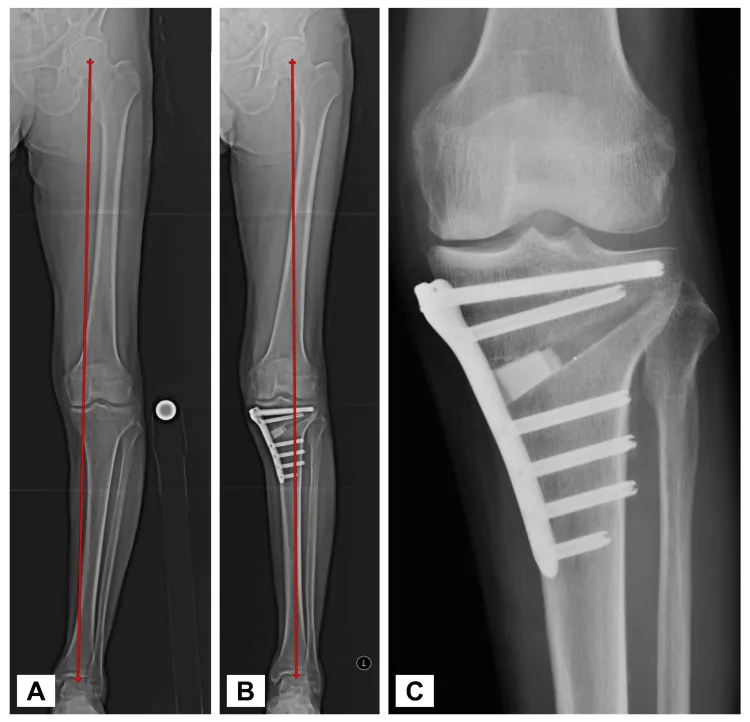
- Full-length standing X-ray (hip to ankle) to measure the mechanical axis and the joint angles of the femur and tibia
- A deformity analysis to confirm where the bow leg comes from. If both the femur and the tibia contribute, a double-level osteotomy may be better.
- MRI to assess the cartilage, menisci and ligaments
- Calculating the exact correction: weight is moved slightly to the outer side of the knee without over-correcting
The operation
The commonest technique is the medial opening-wedge HTO:
- A controlled cut is made across the upper tibia from the inner side, leaving a hinge of bone on the outer side
- The cut is gently opened to the planned angle, straightening the leg
- It is fixed with a locking plate, and the gap fills with new bone over the following months (a bone graft is sometimes added)
- Knee arthroscopy is often done at the same sitting to treat the meniscus or cartilage
A lateral closing-wedge osteotomy is an alternative in selected cases.
| Medial opening-wedge HTO | Lateral closing-wedge HTO | |
|---|---|---|
| How | Bone opened from the inner side | A wedge of bone removed from the outer side |
| Advantages | One cut; fine-tuning of the correction; no fibula surgery | Bone-on-bone contact heals quickly |
| Considerations | Gap fills with new bone over months | Shortens the leg slightly; the fibula must also be addressed |
See a real case
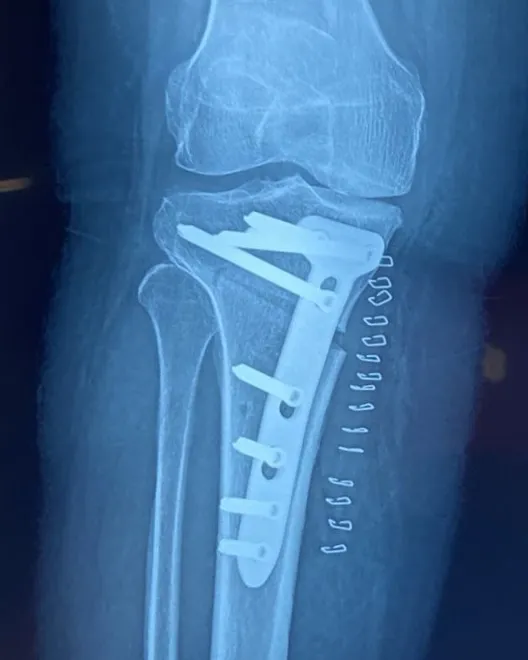
Arthroscopic meniscus root repair + high tibial osteotomy (HTO)
Knee pain labelled 'early arthritis': meniscus root tear repair with HTO
A woman in her late forties was told she had early arthritis and given physiotherapy and painkillers. The real cause was a medial meniscus root tear in a bow-legged knee.
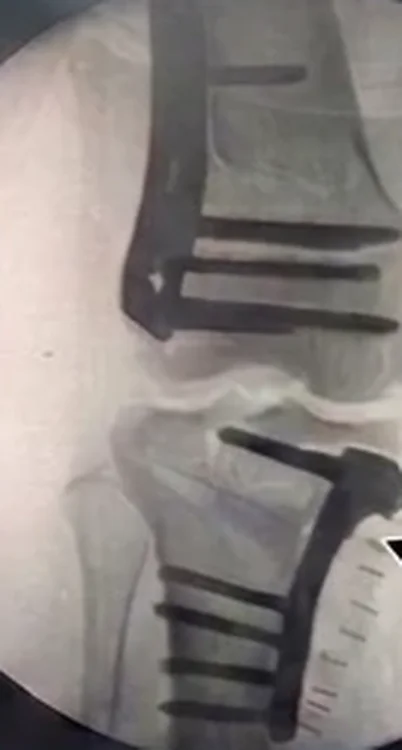
Double-level osteotomy (femur and tibia) with plate fixation
Painful bow-legged (varus) knee: deformity correction with osteotomy
A painful, functionally limiting bow-legged (varus) knee. The deformity was measured on standing X-rays and corrected by osteotomy of both the thigh bone and the shin bone.
Shared with written patient consent, identifying details removed. Individual outcomes vary.
Recovery
Typical timeline in my practice; your plan may differ.
| Time | What to expect |
|---|---|
| Day 1 | Walking with crutches; knee bending begins |
| 0–6 weeks | Partial weight bearing as advised, with physiotherapy for movement and quadriceps |
| 6–8 weeks | X-ray check; progress to full weight bearing |
| 3 months | Most daily activities, cycling and swimming |
| 4–6 months | Return to running and sport once the bone has healed |
Results
Well-selected patients have significant pain relief and can return to active lifestyles, including sport. In pooled studies, roughly 85–92% of knees had not needed a replacement 10 years after HTO,[1] and when one is eventually needed, it can still be done.
HTO, TCVO or DFO: which osteotomy?
Not every knee needs the same operation:
- HTO: early to moderate inner-knee arthritis, stable knee, bowing in the tibia
- TCVO (tibial condylar valgus osteotomy): more advanced inner-knee arthritis where the outer joint has opened up and the knee wobbles; the L-shaped cut corrects alignment and closes the joint gap
- Double-level osteotomy (DLO): severe bowing from both femur and tibia
- Distal femoral osteotomy (DFO): the opposite problem, knock-knee alignment overloading the outer knee
HTO is often combined with cartilage repair or meniscus root repair, because correcting the load protects the repair.
Why limb-reconstruction training matters
Osteotomy is deformity surgery. Training in limb reconstruction and deformity correction means the whole leg is analysed, not just the knee, so the correction is made at the right level and the joint line stays level.
References
- Kim JH, Kim HJ, Lee DH. Survival of opening versus closing wedge high tibial osteotomy: a meta-analysis. Sci Rep. 2017;7(1):7296. PMID 28779084. pubmed.ncbi.nlm.nih.gov/28779084/
Frequently asked questions
Who is HTO suitable for?
HTO is best for active patients, usually under about 60, with bow legs and arthritis or cartilage damage limited to the inner side of the knee, good knee movement and a stable joint. It is also used with cartilage or meniscus procedures to protect them.
Is HTO better than knee replacement?
HTO keeps your own knee joint, and many patients return to high-demand activity once the bone has healed, which suits younger, active people. A knee replacement is better for advanced arthritis in more than one compartment. HTO can be converted to a knee replacement later if needed.
How long is recovery after HTO?
Most patients use crutches with partial weight bearing for about 4–6 weeks, return to desk work in 4–6 weeks, and return to sport at 4–6 months once the bone has healed.
Medical disclaimer: this article is general information, not a diagnosis. Every injury is different — please consult an orthopaedic surgeon with your scans before deciding on treatment.