

 By Dr. Himanshu Singh, MBBS, D'Ortho, DNB (Orthopaedics)
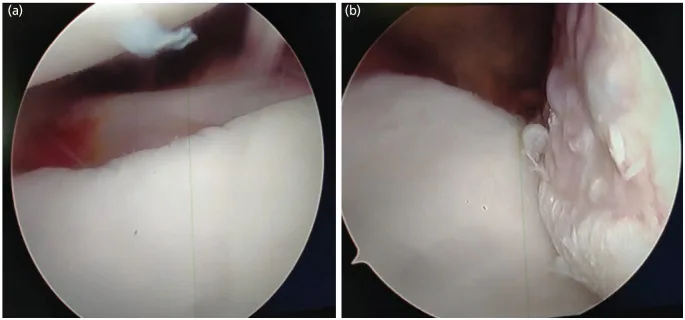
After a shoulder dislocation, the labrum, the ring of cartilage that deepens the socket, is often torn off the front of the glenoid. This is the Bankart lesion. Without its "bumper", the ball can slip out again with less and less force. An arthroscopic Bankart repair reattaches the labrum and tightens the stretched capsule, restoring stability.
Who is suitable?
- Recurrent dislocations or episodes of the shoulder "slipping"
- Apprehension: fear of the shoulder coming out when the arm is raised and turned
- A young athlete after a first dislocation in a high-risk sport, in selected cases
- MRI or MR arthrogram confirms a Bankart lesion
- A 3D CT scan shows little or no bone loss from the socket
If the CT shows significant bone loss, a soft-tissue repair alone may not hold. A Latarjet procedure is then the better choice.
The operation
Through two or three small keyhole incisions, using a camera:
- The joint is inspected, and all damage is assessed (labrum, capsule, rotator cuff, cartilage)
- The torn labrum is freed and the bone of the socket rim is prepared to promote healing
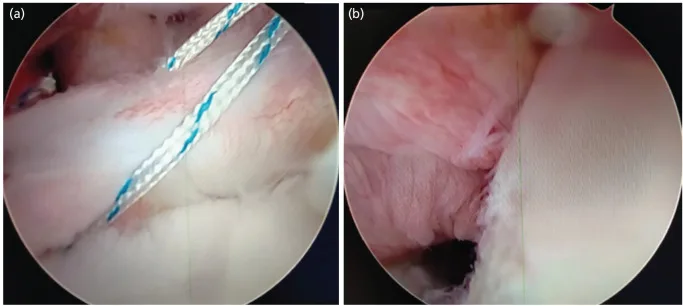
- Small suture anchors are placed in the socket rim
- The labrum and capsule are reattached and tensioned with the sutures
Remplissage
If there is an engaging Hill-Sachs lesion (a dent in the back of the ball that catches on the socket edge), a remplissage is added: the back of the capsule and the infraspinatus tendon are stitched into the dent, preventing it from engaging.
The operation takes about 1–1.5 hours under general anaesthesia with a nerve block. Most patients go home the same day or the next.
Recovery timeline
Typical timeline in my practice; your plan may differ.
| Time | What to expect |
|---|---|
| 0–4 weeks | Sling; elbow, wrist and gentle pendulum exercises |
| 4–6 weeks | Sling off; assisted movement restored gradually |
| 6–12 weeks | Strengthening of rotator cuff and shoulder-blade muscles |
| 3–4 months | Running, swimming, gym work with guidance |
| 5–6 months | Return to contact and overhead sport after a functional assessment |
Desk work is usually possible at 1–2 weeks and driving at about 6 weeks. See the shoulder recovery guide.
Why keyhole?
Arthroscopic repair uses small incisions and allows a full inspection of the joint, so other injuries are treated in the same sitting. In long-term studies, arthroscopic and open repair gave similar stability and function.[1]
Don't wait for many more dislocations
Each dislocation can damage more labrum, cartilage and bone. Addressing recurrent instability early can keep the operation simpler, before bone loss builds up.
References
- Harris JD, Gupta AK, Mall NA, et al. Long-term outcomes after Bankart shoulder stabilization. Arthroscopy. 2013;29(5):920-33. PMID 23395467. pubmed.ncbi.nlm.nih.gov/23395467/
Frequently asked questions
Is a Bankart repair a big operation?
It is keyhole (arthroscopic) surgery through two or three small incisions, usually as a day case or with one overnight stay. Most of the effort is in the rehabilitation that follows.
Can the shoulder dislocate again after Bankart repair?
Most patients do not dislocate again; in long-term studies roughly 1 in 10 had recurrent instability after arthroscopic repair. The risk is higher in young contact athletes and when there is significant bone loss, which is why a CT scan is used to decide between a Bankart repair and a Latarjet procedure.
When can I play sport after a Bankart repair?
Non-contact sports such as swimming and running usually resume at about 3–4 months, and contact or overhead sports such as cricket, kabaddi, football and rugby around 5–6 months once strength and confidence have returned.
Medical disclaimer: this article is general information, not a diagnosis. Every injury is different — please consult an orthopaedic surgeon with your scans before deciding on treatment.